How Can Alternative Practices Reduce Human Impact on Waterways
How our daily travel harms the planet
(Prototype credit:
Getty Images/Javier Hirschfeld
)
Private send is one of the earth's biggest sources of greenhouse gases, with emissions ascension every year. In our car dominated cities, can we cut downwards the carbon footprint of our daily commute?

For many people, the journey to and from work are the bookends of the daily grind. But how nosotros choose to travel to the office, or even to pop to the shops, is likewise one of the biggest mean solar day-to-day climate decisions we face up.
In countries like the United kingdom and the US, the transport sector is at present responsible for emitting more greenhouse gases than any other, including electricity production and agriculture. Globally, transport accounts for effectually a quarter of CO2 emissions.
And much of the world's transport networks still remain focused effectually the auto. Route vehicles – cars, trucks, buses and motorbikes – account for nearly three quarters of the greenhouse gas emissions that come from transport.
And so, the way yous get around each day can make a large departure to your ain carbon footprint.
You lot might also similar:
● Should you get on a "flight diet"?
● Why your bin is a climate trouble
● The surprising price of being online
If you use a car frequently, the kickoff step to cutting downward your emissions may well exist to simply fully consider the alternatives available to you.
The boilerplate petrol auto on the road in the Britain produces the equivalent of 180g of CO2 every kilometre, while a diesel car produces 173g of CO2/km. In the US the boilerplate passenger vehicle on the road releases 650g of CO2/km. More often than not, the larger the car, the higher the emissions.
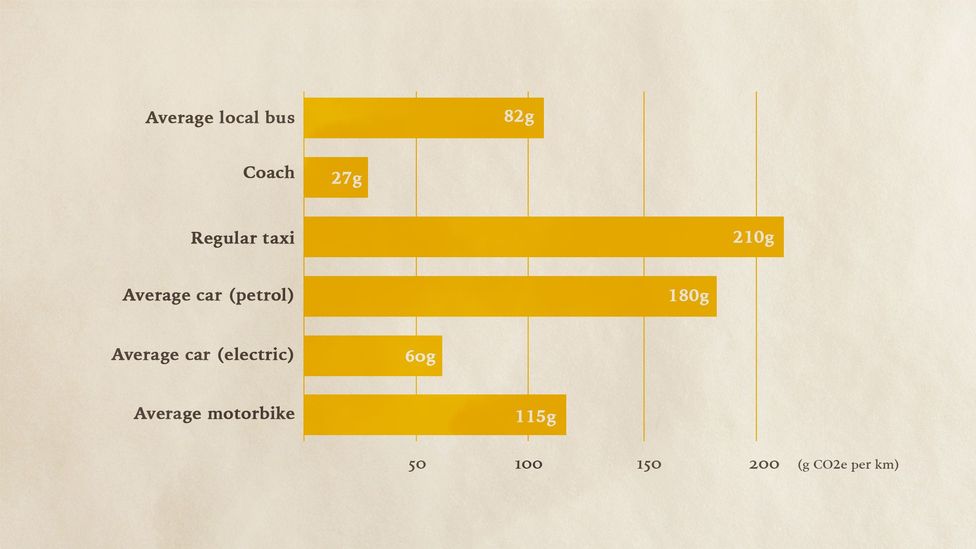
Traveling past private car or in a taxi emits far more carbon than making a journey by coach or rail (Credit: BEIS Conversion factors 2019/Javier Hirschfeld)
Driving a newer vehicle can reduce these emissions – in Europe the boilerplate emissions for a new petrol automobile in 2022 was 123g of CO2/km.
Just in many cases it may exist possible to avoid using the motorcar altogether. In many countries, even short journeys which could often be made on foot or by wheel are ordinarily fabricated past automobile. In England, for example, effectually 60% of 1-two mile trips are made by car.
"From our perspective, the really depression hanging fruit is the journeys that people could walk," says Stephen Edwards, head of policy and communications at Living Streets, a British charity that promotes walking. "There's an immediate contribution that nosotros could all brand to reducing our personal carbon emissions by walking more of those curt journeys, whether it be to school, to the shops, to work or to the station."
People often face psychological barriers to walking, says Edwards, and Living Streets aims to support people equally they endeavour to change their behaviour. During National Walking Calendar month in May, it encourages people to substitute just one short car journey a day for a walk, and to experiment with incorporating walking into their daily routine.
"I call up in one case people first making that change, then information technology becomes sustained over time and the majority keep it upwardly afterward May," says Edwards.
Reducing machine use on the schoolhouse run is another focus for Living Streets. A generation ago, 70% of British children walked to schoolhouse, but now less than half practise, despite studies showing children who walk or wheel to schoolhouse tend to be more than focused and are less probable to be overweight. Fewer cars around the schoolhouse gate also means less local air pollution.
Dom Jacques, a parent of two from Leeds, in the United kingdom of great britain and northern ireland, decided to practice something when he became frustrated at the amount of congestion at the gates of his children'south school. Concerned nearly the potential impacts of air pollution and cluttered traffic on minor children, he set up a local group to advocate for boyfriend parents to avert driving their cars upward to the school, and convinced the schoolhouse to go involved with the Living Streets walk to school programme.

A generation ago, 70% of British children walked to school, but at present less than one-half do that (Credit: Getty Images/Javier Hirschfeld)
"The children were being educated nearly the benefits of walking on a daily basis," he says. "They log their journeys on a daily ground as function of the project, they get really involved in the process… So y'all can track whether or not y'all've been successful. Information technology gives you a real insight into what's happening."
Living Streets says walk to school rates take increased by 23% later on v weeks in schools where its programme take been implemented, while car journeys accept fallen past around 30%.
Cycling, which shares many of the climate benefits of walking, is increasingly a feasible alternative to car journeys, too. Some countries accept sped ahead in bike transport: in holland 26% of journeys are made by bike, followed by Denmark on xviii% and 10% in Germany. All three countries had major policy changes in the 1970s and 1980s that led to a large increase in cycling, and all yet continue to invest in cycling infrastructure.
Ofttimes people may discard cycling as a feasible choice for longer altitude travel. But electrical bikes and networks of segregated cycle lanes are get-go to change what is possible in terms of commuting distance, says Leo Murray, managing director of innovation at climate change charity Possible (formerly ten:10 Climate Action).
Pressuring local authorities to provide more than public transport and create infinite for cyclists is the best way to reduce reliance upon cars (Credit: Getty Images/Javier Hirschfeld)
In Copenhagen's Farum wheel pike, the boilerplate bicycle commute is now 15km (nine miles), largely thanks to electric bikes. A recent report from advocacy organisation Ship for Quality of Life argued prove from Europe shows electric bikes can transform our cities and should exist financially incentivised in places like the UK. "Journeys that you lot just wouldn't accept made by bicycle before, at present are really piddling to make by due east-cycle," says Murray. "And they are faster because you never sit in a traffic jam. The same is true to an extent for electrical scooters."
Many people, though, view public transport as the most obvious manner to reduce their send emissions, and it is especially of import in the nearly congested urban areas. "All the economics are points in favour of it," says Claire Haigh, main executive of British sustainable travel organisation Greener Journeys.
Travelling on light rail or the London Underground emits around a 6th of the equivalent car journey, according to UK regime figures. A passenger vehicle ride produces lower emissions still. Taking the local bus currently emits more than, perhaps because the vehicles travel at lower speeds and pull over more oftentimes. But taking a local passenger vehicle emits a little over half the greenhouse gases of a single occupancy car journey and also assist to remove congestion from the roads. Double-decker emissions will become down farther every bit more and more cities implement plans for electric and hydrogen buses.
Walking to and from the motorcoach stop also gives people on average one-half their weekly recommended practice, according to Greener Journeys research. "The great matter about public send is it is besides agile," says Haigh.
It is important to recognise, however, that tackling emissions from ship too relies on structural changes which people may not be able to influence by their daily habits. "The motor car authorisation ways that it actively militates confronting you making more responsible choices," says Murray. "What y'all have to exercise is modify the conditions in which the choices are being fabricated so they are more favourable to more than responsible choices."
Local regime and policy makers around the world need to implement measures to assistance these journeys get both more viable and bonny. People will be more probable to desire to walk and bike if measures to brand streets feel safer and more pleasant – such as low speed zones for cars, widening pavements or building cycle lanes – are put in place. Likewise, buses will be much more attractive if the routes are convenient and well communicated, motorcoach lanes are available, and buses are accessible and welcoming. In some cases, it can even make sense to make them costless.
But this does not hateful people should simply wait for a public authority to cut the carbon footprint of their daily travel for them – quite the opposite, says Murray. "You can campaign in your local community, work through residents' associations, work with your neighbours, to assist to change the choice architecture that is determining everybody'southward decisions."
Equally Haigh puts it, "If you lot don't ask, yous don't become".
Many short journeys made by car could easily be made on foot or by bike if the right infrastructure is in identify (Credit: Getty Images/Javier Hirschfeld)
For example, Murray, who lives on a garden foursquare in West London, teamed up with other residents in the neighbourhood to push his local quango to install on-street electric vehicle chargers, for which there was a authorities grant available. After realising there was demand from several families, the quango installed the chargers.
"Nosotros at present have electric charge points installed in the lamp post on my foursquare," he says. "As a result, three households on the square have at present switched to electrical vehicles."
Murray and a group of local parents similarly advocated for a proposed wheel lane almost his house. "We formed effectively a council foyer that has helped to embolden the quango to go on with these plans," he says.
At that place are many innovative ideas being implemented in cities around the world to help people reduce the carbon footprint of their daily commute, says Edwards. The Paris Mayor Anne Hidalgo, for case, has embraced the idea of a 15-minute city, where all the services people need – including their workplaces – are situated in close proximity to where they live. Information technology would require a desperate redesign of Paris city centre, just the benefits would be huge.
"That is near planning urban development so that wherever people alive, everything that they need is within 15 minutes of walking or cycling or public ship," says Murray. "Arranging urban spatial geography effectually that basic organising principle is actually the near of import matter that you lot tin practice to start to erode car dominance."
Of form, there are some journeys that volition e'er be tricky to do by public ship, bike or foot. For many living in rural areas, for instance, the car is oft the only realistic send option. Similarly, for elderly people or those with a disability, cars may exist the only feasible means of transport.
For those continuing to utilise a car, choosing the most fuel-efficient model available tin make a large deviation. Ship emissions are still growing globally because of the growing appetite for SUVs over smaller vehicles, a trend which risks cancelling out the benefits switching to electric cars. A decade agone SUVs made up 17% of global yearly car sales, but at present account for 39%. According to the International Free energy Agency, this demand for larger cars was the 2nd largest contributor to the increment in global CO2 emissions between 2010 and 2018.
"Non simply are people driving more, but besides the vehicles, unfortunately, aren't actually getting more than carbon efficient," says Heigh. "So that's a large problem."
A large car emits on average 85% more greenhouse gases per km than a small vehicle, according to figures from the UK government. Electrical cars are the lowest carbon – they emit effectually a third of the CO2 of a petrol auto in the UK, although this figure will vary from country to country depending on how much fossil fuels are even so used to produce electricity. The auto stock on the roads volition also alter this – cars on the roads in the US are generally larger and less efficient than those in Europe, for example.
Automobile sharing initiatives, which allow you to rent a motorcar without owning one, are increasingly becoming an option for those living in cities and towns. Studies have shown these accept the ability to significantly reduce the number of cars on the roads.
"In a context where you've really got public authority bringing in policies to make private car ownership and use less bonny, these are probably a very important part of the solution," says Murray.
For some, a sensible-seeming solution would be to turn to taxis and ride hailing through apps such as Uber and Lyft. But these may be higher carbon emitters than you lot realise. One recent written report past the Spousal relationship of Concerned Scientists in the US found ride-hailing services emits 69% more climate pollution on average than the journeys they displace, and 47% more than an equivalent individual car ride due to the extra passenger-free driving they do while waiting for a fare – known as "deadheading". But pooling rides, choosing rides in electric vehicles, or using ride hailing to connect with public transport all produce less emissions than a individual car, the report found. And ride hailing will likewise reduce the need for on-street parking – freeing up more than infinite in dense cities.
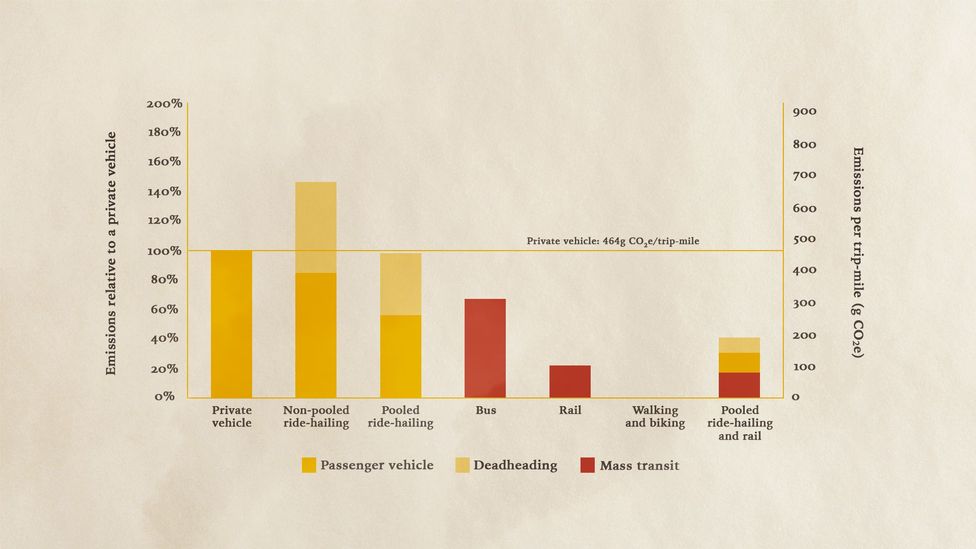
Due to "deadheading" – journeys fabricated without passengers – ride hailing services often emit more than carbon than many alternatives (Credit: Union of Concerned Scientists)
Some countries are now seeing innovative new alternatives appearing, such every bit on-need buses and other "microtransit" options. Arrivaclick's flexible minibus service, for example, has begun schemes in Liverpool, Leicester and Watford, while startup Via has launched a pilot on-demand shuttle in Cupertino, California. Until schemes like this get more mainstream, however, car-pooling remains one of the main options for reducing your individual emissions of using a machine.
"One thing that would exist really expert would be if people could only think, don't e'er become in a auto on your own," says Haigh. "If you're going to do a journeying by machine, brand certain you lot fill up that car up with at least ane other person."
One terminal style you may be inadvertently leading to send emissions and congestion in your surface area is your online shopping habits. The huge growth in internet shopping has caused the number of vans to skyrocket in many cities due to dwelling house deliveries.
Merely the modify in greenhouse gas emission impacts from home deliveries is still uncertain, says Susan Shaheen, co-director of the Transportation Sustainability Research Center at the University of California. "While e-commerce can create demand for additional deliveries, it tin as well reduce the number of retail trips a household makes," she says.
In either example, i way to reduce dwelling delivery emissions is for packages to arrive using postal services, which typically serve a location once a twenty-four hours, says Shaheen. You could besides become parcels delivered to your local post office, avoid one-day deliveries and apply companies that deliver using low carbon transport.
For many of usa, taking activeness to reduce the emissions from your daily transport can be catchy on an individual level, but even but cut out one or two journeys could make a unlike while pushing those in charge to make information technology easier for us to switch to greener vehicles.
By doing our bit we may one day be living in the salubrious, green cities and so many of us dream of.
--
Smart Guide to Climate Modify
For most BBC Future readers, the question of whether climatic change is happening is no longer something that needs to be asked. Instead, there is at present growing concern about what each of us every bit individuals can practice most it. This new serial, our "Smart Guide to Climatic change", uses scientific research and data to break downwards the nearly constructive strategies each of u.s.a. can have to compress our carbon footprint.
--
Join one million Time to come fans by liking us on Facebook , or follow u.s. on Twitter or Instagram .
If you liked this story, sign up for the weekly bbc.com features newsletter , called "The Essential List". A handpicked pick of stories from BBC Hereafter, Civilization, Worklife, and Travel, delivered to your inbox every Friday.
Source: https://www.bbc.com/future/article/20200317-climate-change-cut-carbon-emissions-from-your-commute

Post a Comment for "How Can Alternative Practices Reduce Human Impact on Waterways"