Asrock Rack Epycd8-2t / Epycd8 Review Tesla V100
ASRock Rack EPYCD8-2T Conclusion
Professional grade motherboards are a completely different playing field when it comes to the consumer-focused models. The principal differences aside from featuring much plainer and archaic aesthetics, come up via the onboard controller set. This includes the use of BMC controllers to permit users to connect for vital maintenance and monitoring from distant locations. ASRock Rack has been around since 2013 and until 2018, information technology produced models for Intel. The first board created for AMD';s EPYC from ASRock Rack was the EPYCD8, with the chief difference between that and the EPYCD8-2T coming through its choice of primary networking controller. The newer EPYCD8-2T includes an Intel X550 Dual x G Ethernet controller which adds two ports on the rear. Everything else between both models remains unchanged.
The ASRock EPYCD8-2T includes seven PCIe 3.0 slots, which is an is an impressive feat given the lath is ATX. They run in a x16/x8/x16/x8/x16/x8/x16 configuration, with the 4 full-length slots running at the full x16 bandwidth, and the half-length slots running at x8. 1 of the biggest benefits of AMD's EPYC is that each processor has 128 available PCIe lanes, which the ASRock model takes full advantage of. Also benefiting from the PCIe capability is 2 PCIe 3.0 x4 M.2 slots, with two Oculink slots for U.2 drives, with support for upwardly to nine SATA devices via 2 mini SAS Hd ports, with a unmarried SATA DOM powered connector.
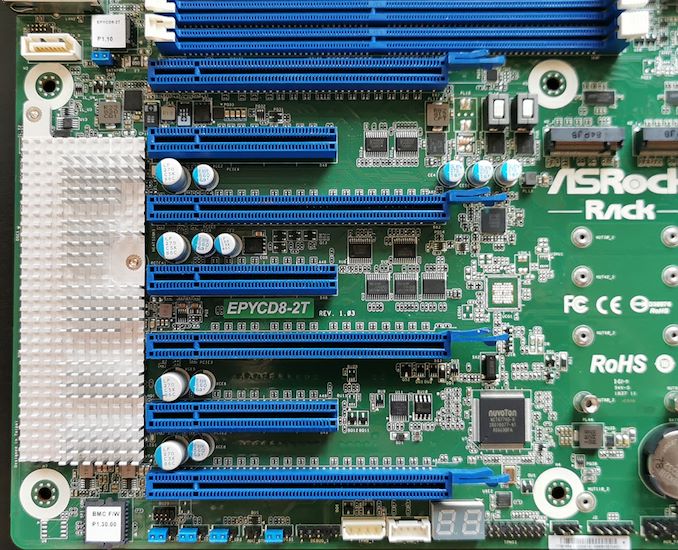
The ASRock EPYCD8-2T has seven PCIe 3.0 slots
To connect remotely to a arrangement using this model, users can access it over a network using a Realtek RTL8211E Gigabit Ethernet port designed for the boards IPMI. The Aspeed AST2500 BMC adds a D-sub 2D video output on the rear console which allows users to run without a graphics card installed. The management interface itself is very well-rounded with a clean GUI and offers plenty of server-level functions. The memory support includes eight slots which support upwards to DDR4-3200 of RDIMM and LRDIMM ECC retentiveness and a maximum capacity of up to 1 TB.
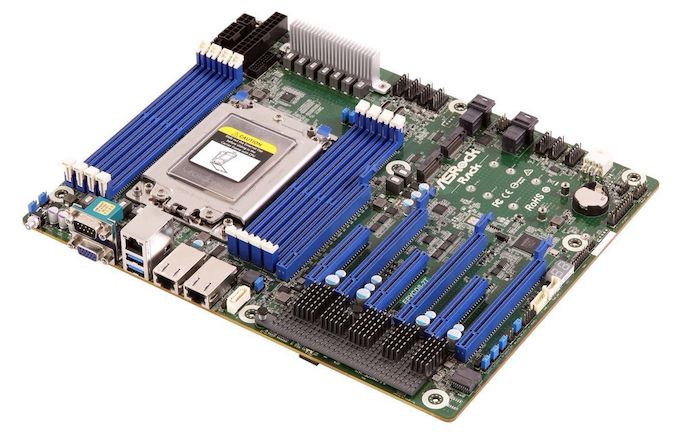
Looking at the performance, and the EPYCD8-2T is very competitive from a computational standpoint. The real difference came in our power consumption testing which puts it every bit the more power-efficient model when compared directly to the GIGABYTE model. Another highly positive event came in our DPC latency testing, with the lowest latency achieved from whatever model tested over the last few years. This makes the EPYCD8-2T very suitable for an audio workstation, despite non including any onboard audio; audio producers generally employ much college class audio equipment anyway. Results in our Mail service time testing were also favourable with the ASRock board booting into Windows around 20 seconds quicker than the GIGABYTE counterpart.
Bigger sized boards such equally E-ATX models can cram more memory slots on, merely the EPYCD8-2T is 'ahead' of its size in terms of specifications with its great storage capability spearheaded by dual PCIe 3.0 x4 M.2 slots, and support for up to nine SATA drives. The ASRock EPYCD8-2T retails for $498 with dual 10 G Ethernet, or alternatively users satisfied with dual Gigabit Ethernet can save some budget with the EYPCD8 ($460) coming in at around $forty cheaper. For comparative purposes, the larger E-ATX sized GIGABYTE MZ31-AR0 which we previously reviewed retails for $565, had more memory slots (16 versus 8) and offering upwardly to ii TB. Existence ATX ways the ASRock EPYCD8-2T is compatible with more chassis types, including 1U chassis, and conventional desktop cases.
Overall the ASRock Rack EPYCD8-2T is a solid single-socket EPYC solution for users not interested in PCIe 4.0 but nonetheless want plenty of PCIe and storage availability in a single socket ATX course factor.
CPU Performance, Short Form
Source: https://www.anandtech.com/show/14171/the-asrock-rack-epycd8-2t-motherboard-review/7

Post a Comment for "Asrock Rack Epycd8-2t / Epycd8 Review Tesla V100"