Center of Interest in Art Definition Byzatine Art Definition
Byzantine fine art (4th - 15th century CE) is generally characterised by a move away from the naturalism of the Classical tradition towards the more than abstract and universal, at that place is a definite preference for two-dimensional representations, and those artworks which incorporate a religious bulletin predominate. However, by the 12th century CE Byzantine art has become much more expressive and imaginative, and although many subjects are incessantly recycled, there are differences in details throughout the period. Whilst it is truthful that the vast bulk of surviving artworks are religious in subject, this may exist a consequence of selection in subsequent centuries as in that location are abundant references to secular art in Byzantine sources and pagan subjects with classical iconography continued to be produced well into the 10th century CE and beyond. Using bright stones, gold mosaics, lively wall paintings, intricately carved ivory, and precious metals in general, Byzantine artists beautified everything from buildings to books, and their greatest and most lasting legacy is undoubtedly the icons which keep to decorate Christian churches around the world.
Influences
As Byzantium was the eastern branch of the Roman Empire in its primeval stage, it is not surprising that a strong Roman, or more precisely, Classical influence predominates Byzantine output. The Roman tradition of collecting, affectionate, and privately displaying antique art likewise continued among the wealthier classes of Byzantium. Byzantine fine art is at once both unchanging and evolutionary, themes such every bit the Classical traditions and conventional religious scenes were reworked for century after century, simply at the same time, a closer examination of individual works reveals the details of an ever-irresolute approach to art. As with modern movie theater that regularly remakes a familiar story with the same settings and the same characters, Byzantine artists worked within the limits of the practical end function of their piece of work to make choices on how best to nowadays a subject, what to add and omit from those new influences which came along, and, by the terminate of the menstruation, to personalize their piece of work equally never before.
In the Byzantine Empire, there was footling or no stardom between creative person & craftsperson, both created beautiful objects for a specific purpose.
It is perhaps of import to recall that the Byzantine Empire was much more Greek than Roman in many aspects and Hellenistic art continued to be influential, especially the idea of naturalism. At the same time, the geographical extent of the empire also had its implications for art. In Alexandria the more rigid (and for some, less elegant) Coptic style took off from the 6th century CE, replacing the predominant Hellenistic style. Half-tone colours were avoided and brighter ones were favoured while figures are squatter and less realistic. Some other area of creative influence was Antioch where the 'orientalizing' style was adopted, that is the absorption of motifs from Western farsi and primal Asian art such every bit ribbons, the Tree of Life, ram's heads, and double-winged creatures, as well as the total frontal portraits which appear in the art of Syria. In turn, the fine art of these great cities would influence that produced in Constantinople, which became the focal bespeak of an art industry that spread its works, methods, and ideas throughout the Empire.
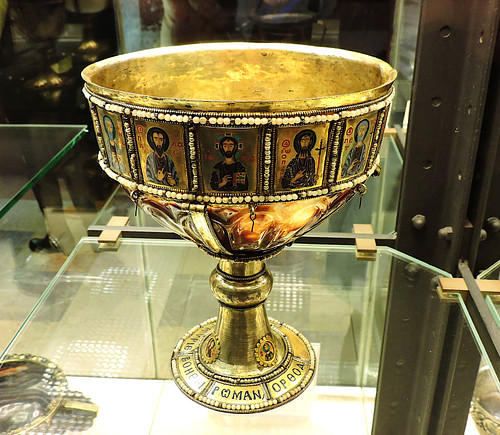
Byzantine Chalice
The Byzantine Empire was continuously expanding and shrinking over the centuries, and this geography influenced art equally new ideas became more readily attainable over fourth dimension. Ideas and fine art objects were continuously spread betwixt cultures through the medium of royal gifts to fellow rulers, diplomatic embassies, religious missions, and souvenir-ownership wealthy travellers, not to mention the movement of artists themselves. From the early on 13th century CE, for instance, Byzantium was influenced past much greater contact with western Europe, just as it had been when the Byzantines were more present in Italy during the 9th century CE. The influence went in the other direction, too, of form, so that Byzantine artistic ideas spread, notably outwards from such outposts equally Sicily and Crete from where Byzantine iconography would get on to influence Italian Renaissance art. Then, too, in the north-east, Byzantine art influenced such places equally Armenia, Georgia, and Russia. Finally, Byzantine art is still very much alive as a strong tradition within Orthodox art.
Artists
In the Byzantine Empire, there was trivial or no distinction betwixt artist and craftsperson, both created cute objects for a specific purpose, whether it be a box to go along a precious belonging or an icon to stir feelings of piety and reverence. Some job titles we know are zographos and historiographos (painter), maistor (main) and ktistes (creator). In addition, many artists, notably those who created illustrated manuscripts, were priests or monks. In that location is no evidence that artists were non women, although it is likely they specialised in textiles and printed silks. Sculptors, ivory workers, and enamelists were specialists who had acquired years of preparation, but in other fine art forms, it was common for the aforementioned artist to produce manuscripts, icons, mosaics, and wall paintings.
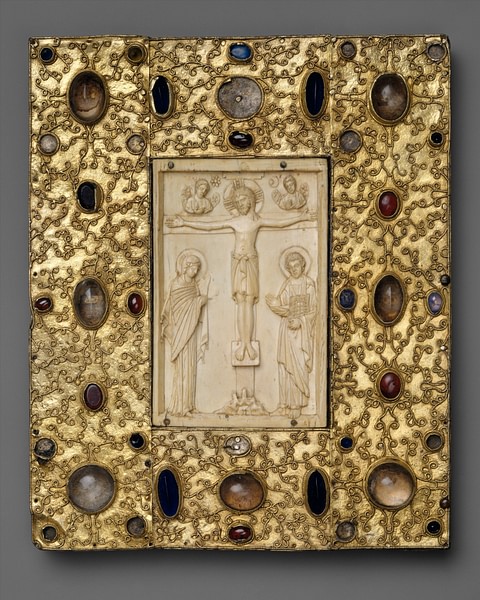
Byzantine Volume Cover with Icon
It was rare for an artist to sign their piece of work prior to the 13th century CE, and this may reflect a lack of social status for the artist, or that works were created by teams of artists, or that such personalization of the artwork was considered to backbite from its purpose, especially in religious art. Artists were supported by patrons who commissioned their work, notably the emperors and monasteries only also many private individuals, including women, peculiarly widows.
Frescos & Paintings
Byzantine Christian art had the triple purpose of beautifying a building, instructing the illiterate on matters vital for the welfare of their soul, and encouraging the faithful that they were on the correct path to salvation. For this reason, the interiors of Byzantine churches were covered with paintings and mosaics. The large Christian basilica edifice, with its high ceilings and long side walls, provided an platonic medium to transport visual messages to the congregation, simply fifty-fifty the most apprehensive shrines were often busy with an affluence of frescoes. The subjects were necessarily limited - those key events and figures of the Bible - and even their positioning became conventional. A delineation of Jesus Christ usually occupied the central dome, the barrel of the dome had the prophets, the evangelists appear on the joins between vault and dome, in the sanctuary is the Virgin and child, and the walls have scenes from the New Testament and the lives of the saints.
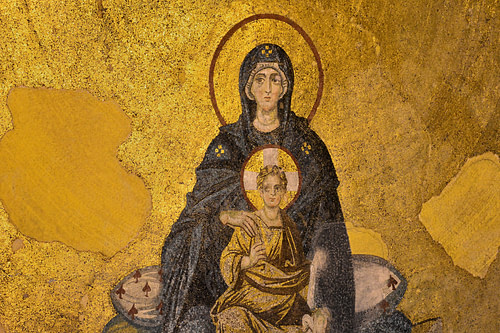
The Virgin and Child Mosaic, Hagia Sophia
Too walls and domes, small painted wooden panels were another popular medium, especially in the late-Empire flow. Literary sources describe small portable portrait paintings which were commissioned by a wide range of people from bishops to actresses. Paintings for manuscripts were too a valued outlet for painting skills, and these encompass both religious subjects and historical events such as coronations and famous battles.
Icons - representations of holy figures - were created for veneration by Byzantine Christians from the tertiary century CE.
Fine examples of the more expressive and humanistic mode prevalent from the 12th century CE are the 1164 CE wall paintings in Nerezi, Macedonia. Showing scenes from the cross, they capture the despair of the protagonists. From the 13th century CE, individuals are painted with personality and there is more attending to particular. The Hagia Sophia in Trabzon (Trebizond) has whole galleries of such paintings, dated to c. 1260 CE, where the subjects seem to have been inspired by real-life models. In that location is as well a more daring employ of colour for upshot. A good instance is the use of blues in The Transfiguration, a manuscript painting in the theological works of John VI Cantacuzenus, produced 1370-1375 CE and now in the Bibliothèque Nationale, Paris. On a larger scale, this combination of bold colours and fine details is best seen in the wall paintings of the diverse Byzantine churches of Mistra in Hellenic republic.
Icons
Icons - representations of holy figures - were created for veneration by Byzantine Christians from the third century CE. They are most oftentimes seen in mosaics, wall paintings, and equally small-scale artworks made from wood, metal, gemstones, enamel, or ivory. The most common form was small painted wooden panels which could exist carried or hung on walls. Such panels were made using the encaustic technique where coloured pigments were mixed with wax and burned into the wood every bit an inlay.
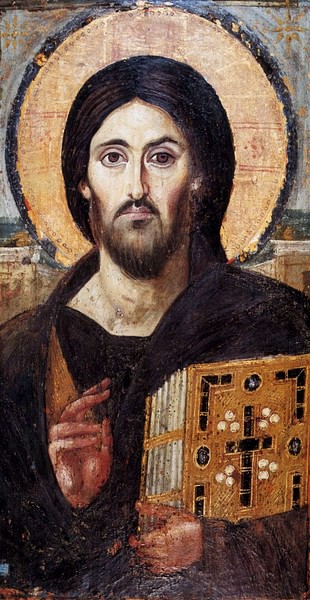
Jesus Christ Pantokrator
The subject area in icons is typically portrayed full frontal, with either the total effigy shown or the head and shoulders only. They stare directly at the viewer every bit they are designed to facilitate communication with the divine. Figures often have a nimbus or halo effectually them to emphasise their holiness. More rarely, icons are composed of a narrative scene. The creative approach to icons was remarkably stable over the centuries, but this should not perhaps exist surprising equally their very subjects were meant to present a timeless quality and instil a reverence on generation after generation of worshippers - the people and fashions might alter only the message did not.
Some of the oldest surviving Byzantine icons are to be found in the Monastery of Saint Catherine on Mount Sinai. Dating to the 6th century CE and saved from the wave of iconoclasm which spread through the Byzantine Empire during the eighth and ninth century CE, the finest evidence Christ Pantokrator and the Virgin and Child. The Pantokrator image - where Christ is in the classic full frontal pose and is holding a Gospel volume in his left mitt and performing a blessing with his correct - was probably donated by Justinian I (r. 527-565 CE) to mark the monastery's foundation.
By the 12th century CE, painters were producing much more intimate portraits with more expression and individuality. The icon known as the Virgin of Vladimir, now in the Tretyakov Gallery in Moscow, was painted in Constantinople c. 1125 CE and is an excellent instance of this new style with its tender representation of the child pressing his cheek against his mother.

Man Feeding Mule, Byzantine Mosaic
Mosaics
The majority of surviving wall and ceiling mosaics draw religious subjects and are to exist found in many Byzantine churches. One of their characteristics is the use of gold tiles to create a shimmering background to the figures of Christ, the Virgin Mary and saints. As with icons and paintings, the portraiture follows certain conventions such as a total frontal view, halo, and general lack of suggested movement. The Hagia Sophia in Constantinople (Istanbul) contains the most historic examples of such mosaics while one of the nigh unusually striking portraits in the medium is that of Jesus Christ in the dome of Daphni in Greece. Produced around 1100 CE, it shows Christ with a rather fierce expression which is in dissimilarity to the usual expressionless representation.
The mosaics of the Great Palace of Constantinople, which date to the 6th century CE, are an interesting mix of scenes from daily life (especially hunting) with pagan gods and mythical creatures, highlighting, once again, that heathen themes were not wholly replaced past Christian ones in Byzantine art. Another secular subject for mosaic artists was emperors and their consorts, although these are oftentimes portrayed in their office as head of the Eastern Church. Some of the most celebrated mosaics are those in the church of San Vitale in Ravenna, Italia, which date to the 540s CE. Ii glittering panels bear witness Emperor Justinian I and his consort Empress Theodora with their respective entourages.
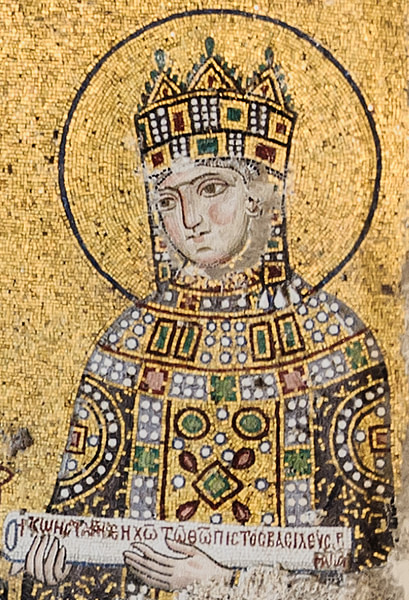
Byzantine Empress Zoe
Byzantine mosaic artists were so famous for their work that the Arab Umayyad Caliphate (661-750 CE) employed them to decorate the Dome of the Rock in Jerusalem and the Great Mosque of Damascus. Finally, just every bit in painting, in the 13th and 14th century CE, the subjects in mosaics become more natural, expressive and individualised. Excellent examples of this style tin can be seen in the mosaics of the Church of the Saviour, Chora, Constantinople.
Sculpture
Realistic portrait sculpture was a feature of later Roman fine art, and the trend continues in early Byzantium. The Hippodrome of Constantinople was known to take statuary and marble sculptures of emperors and popular charioteers, for example. Ivory was used for figure sculpture, too, although only a unmarried free-standing instance survives, the Virgin and Kid, now in the Victoria and Albert Museum, London. Marble and limestone sarcophagi were another outlet for the sculptor's arts and crafts. After the 6th century CE, though, three-dimensional portraits are rare, fifty-fifty for emperors, and sculpture reached nowhere about the popularity it had in antiquity.
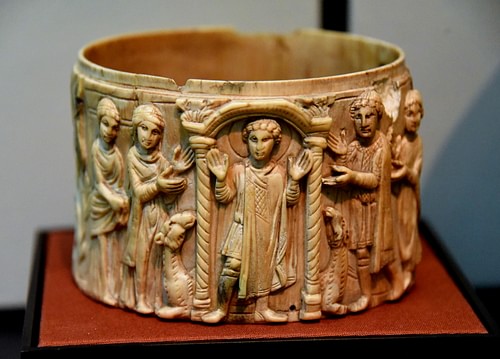
Ivory Pyxis Depicting Saint Menas
Minor Arts
Byzantine artists were accomplished metalsmiths, while enamelling was another expanse of high technical expertise. A superb example of the use of both skills combined is the c. 1070 CE beaker in the Treasury of Saint Mark'south, Venice. Made with a semi-precious stone body and gold stem, the cup is decorated with enamel plaques. Cloisonné enamels (objects with multiple metal-bordered compartments filled with vitreous enamel) were extremely popular, a technique probably acquired from Italy in the ninth century CE. Silvery plates stamped with Christian images were produced in large numbers and used as a domestic dinner service. A final use of metals is coinage, which was a medium for imperial portraiture and, from the 8th century CE, images of Jesus Christ.
Bibles were made with beautifully written text in gold and silverish ink on pages dyed with Tyrian purple and beautifully illustrated. One of the all-time surviving examples of an illustrated manuscript is the Homilies of Saint Gregory of Nazianzus, produced 867-886 CE and now in the Bibliothèque Nationale, Paris. Books, in full general, were oft given exquisite covers using gold, silver, semi-precious stones, and enamels. Reliquaries - containers for holy relics - were another avenue for the decorative arts.
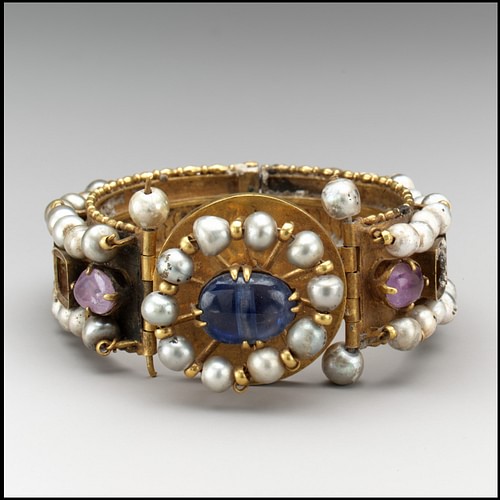
Byzantine Jeweled Bracelet
Portable objects were very frequently decorated with Christian images, and these include such everyday items equally jewellery boxes, ivories, jewellery pieces, and pilgrim tokens. Objects fabricated from ivory such as panels and boxes were a item speciality of Alexandria. Panels were used to decorate almost annihilation but particularly furniture. One of the most celebrated examples is the throne of Maximian, Archbishop of Ravenna (545-553 CE), which is covered in ivory panels showing scenes from the lives of Joseph, Jesus Christ and the Evangelists. Textiles - of wool, linen, cotton fiber, and silk - was another medium for artistic expression, where designs were woven into the cloth or printed by dipping the material in dyes with some parts of the cloth covered in a resistor to create the pattern.
Finally, Byzantine pottery has largely escaped public notice, but potters were accomplished in such techniques every bit polychrome (coloured scenes painted on a white groundwork and then given a transparent glaze) - a technique passed on to Italy in the 9th century CE. Designs were sometimes incised and given coloured glazes, as in the 13th-14th century CE fine plate showing two doves, now in the Collection David Talbot Rice at the University of Edinburgh. Common shapes included plates, dishes, bowls, and unmarried-handled cups. Tiles were oft painted with representations of holy figures and emperors, sometimes several tiles making upward a blended image.
This article has been reviewed for accuracy, reliability and adherence to academic standards prior to publication.
Source: https://www.worldhistory.org/Byzantine_Art/

Post a Comment for "Center of Interest in Art Definition Byzatine Art Definition"